
BESS Capacity Building Programme for BSES Officials
Background
India's path to net-zero emissions by 2070 requires a major shift in its electricity sector, prioritizing high renewable energy (RE) integration while ensuring grid stability and reliability. The National Electricity Plan (NEP)1 projects solar and wind capacity to exceed 480 GW by 2031- 32, significantly increasing the share of intermittent renewables. This large-scale RE adoption poses grid stability challenges, making Energy Storage Systems (ESS) crucial for mitigating RE generation variability, facilitating greater RE penetration, improving grid stability, enabling peak shifting, and providing ancillary support services. Additionally, energy storage helps to reduce peak deficits & peak tariffs, defer transmission and distribution (T&D) infrastructure investments, and enable energy arbitrage.
Recognizing the critical role of energy storage in enabling this transition, the Indo-German development cooperation project ‘Energy Storage for Renewable Energy Integration in India (StoREin2)’ was initiated under the International Climate Initiative (IKI) by the Federal Ministry for Economic Affairs and Climate Action (BMWE), Germany. The project is implemented by the Deutsche Gesellschaft für Internationale Zusammenarbeit (GIZ) GmbH in close cooperation with the Ministry of New and Renewable Energy (MNRE), Government of India. It brings together a consortium of key technical and research partners: Fraunhofer Institute for Energy Economics and Energy System Technology (Fraunhofer IEE), Indian Institute of Technology Bombay (IIT Bombay), The Energy and Resources Institute (TERI), and World Resources Institute India (WRI India).
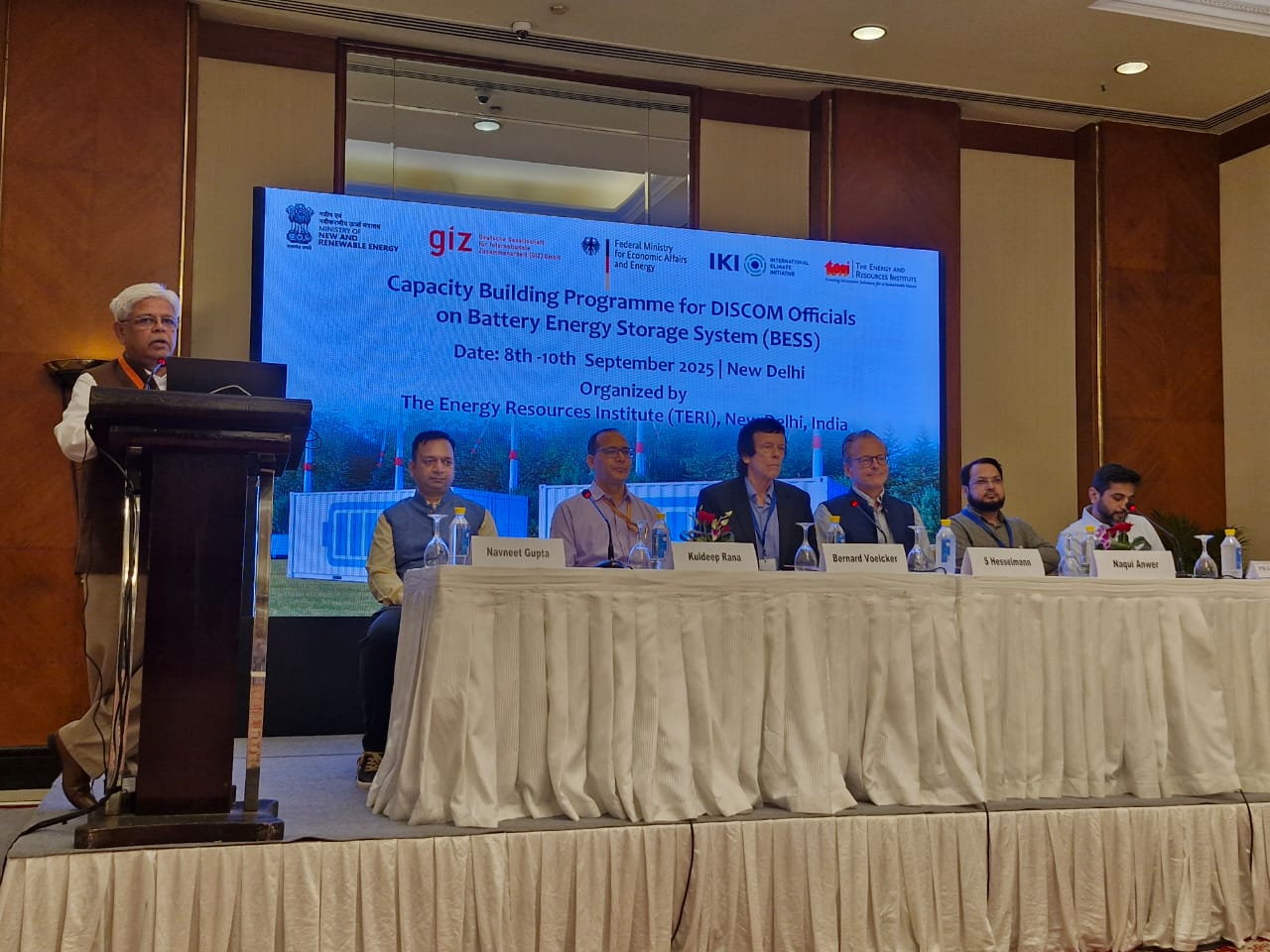
As part of its broader engagement in capacity building under the StoREin project, TERI proposes to conduct a structured training programme for BSES Rajdhani and Yamuna Power Limited (BRPL & BYPL) personnel to strengthen their technical and operational understanding of Battery Energy Storage Systems (BESS). Subject to BRPL’s consent, the programme is also proposing a hands-on study tour to BRPL’s 20 MW/40 MWh BESS site at 33/11kV Kilokari grid sub-station.
- 1 https://cea.nic.in/wpcontent/uploads/irp/2022/09/DRAFT_NATIONAL_ELECTRICITY_PLAN_2022_27_JULY_2022_COMPRESSED_FINAL-1.pdf
- 2 https://www.international-climate-initiative.com/en/project/energy-storage-for-renewable-energy-integration-in-india-storein-22- i-489-ind-g-storage-for-re-integration-storein/
The details of the proposed training programme are given below:
Duration: 3 days; 8th -10th September 2025
Timings: Morning: 10:00 - 13:00 hrs IST & Afternoon: 14:00 - 17:00 hrs IST Mode of Delivery: Hybrid format comprising classroom sessions (in-person/online), interactive discussions, and on-site training.
Link: Join Meeting Certification: Participation certificates will be awarded based on the sessions/days attended.